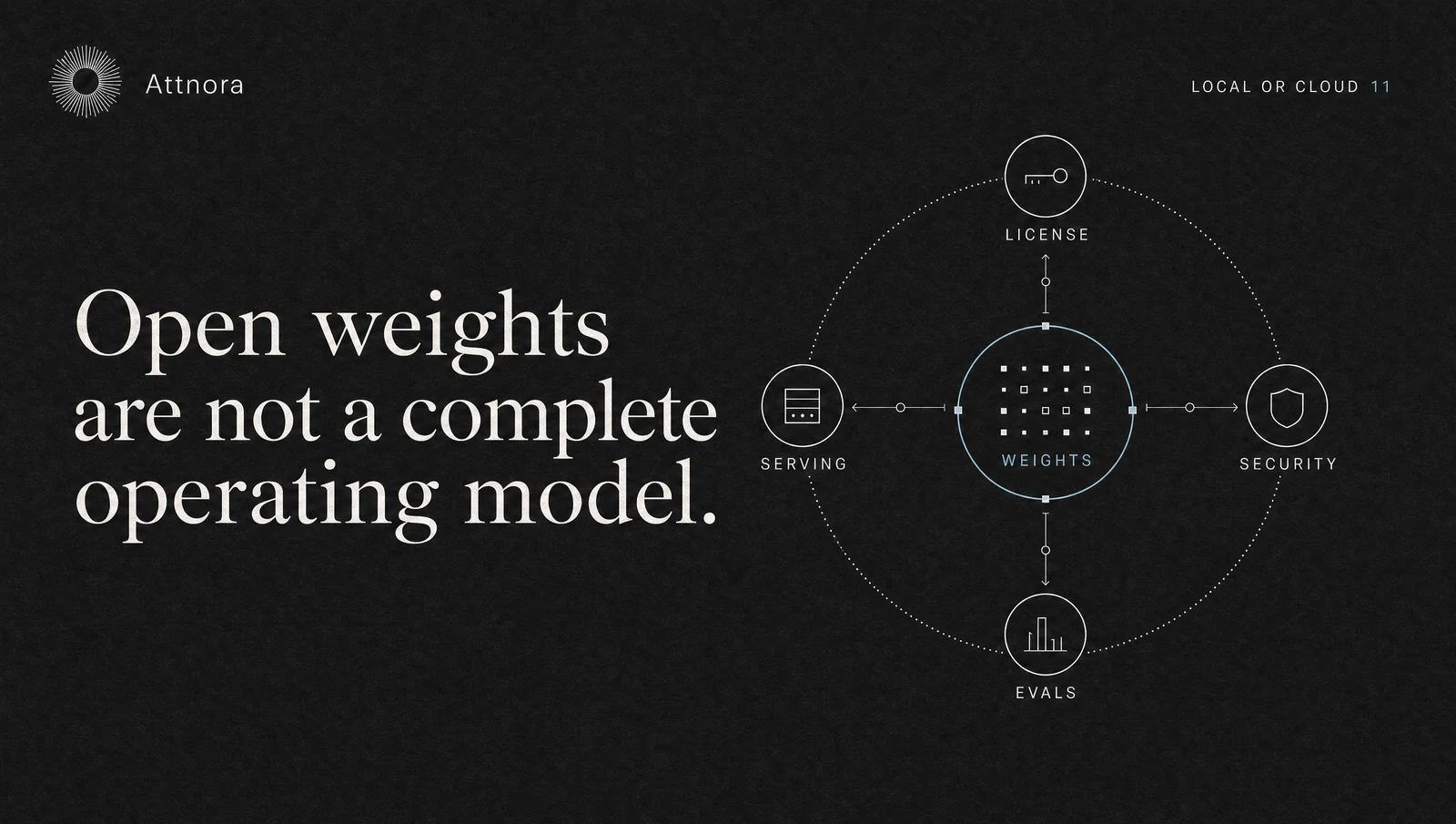
Open-weight models give enterprises direct access to model weights and, depending on the licence, allow self-hosting, customisation, and independent evaluation. This provides control over deployment and the data path. However, it also transfers responsibilities from the provider to the internal team.
On 27 July 2026, Anthropic published its current position on open-weight models. The article reflects the perspective of a model provider and is not a neutral market study. Nevertheless, it highlights an important point: openness is not a single yes-or-no property. Model weights, training data, training code, licences, safety information, and operational access can each have different levels of openness.
There is also a specific, current reference point for the Swiss market: in July 2026, the Swiss AI Initiative released Apertus 1.5 and linked to open 8B and 70B model variants. This makes Apertus a verifiable candidate for Swiss evaluation sets. The release alone, however, does not demonstrate suitability for a particular workflow or lower total costs.
Start by defining the control you need
“We want our own model” is not yet a use case. Clarify what kind of control is required:
- Data must not leave a specific environment.
- Inference must run offline or with low latency.
- Switching providers must remain technically feasible.
- High, stable usage should become more cost-effective.
- The model should be adapted to a narrow task.
Depending on the objective, a managed private environment, a dedicated endpoint, or a hybrid gateway may be sufficient. Self-hosting a model is only one option.
Review licences and usage rights
Open weight does not automatically mean open source. Licences may restrict use, distribution, training, or specific applications. Review the model card, licence text, and dependencies before starting a pilot.
Derived models and quantisations also need evidence of provenance. A technically suitable artefact without a clear licence and provenance is not a reliable foundation for enterprise use.
Operations become part of the product
With self-hosting, the enterprise takes responsibility for capacity planning, patches, access controls, monitoring, scaling, and incident response. Model versions, inference servers, and hardware drivers add further operational duties.
Therefore, do not compare only GPU hours with API tokens. Engineering, on-call coverage, redundancy, utilisation, and evaluation all belong in the total cost calculation.
Security does not end with data location
A locally hosted model can still generate unsafe tool calls, write confidential content to logs, or respond to manipulated documents. Data location reduces certain risks, but it does not replace permissions and agent controls.
Separate model access, source access, and tool permissions. The model itself should never serve as the security boundary.
Test quality on real tasks
Public benchmarks help with initial screening, but they do not represent your documents, languages, tools, or error tolerances. Build an evaluation set from real task types and clearly defined disqualifying errors.
At a minimum, compare quality, latency, throughput, memory requirements, and cost per accepted result. German and Swiss specialist terminology requires dedicated tests.
Plan for replacement and updates
Open weights reduce some dependencies but introduce new ones: the inference framework, hardware, model format, and internal customisations. Document how a model will be replaced, rolled back, and re-evaluated.
A pilot should also answer who will operate the system six months later.
Sources
- Anthropic, Our position on open-weights models: https://www.anthropic.com/news/position-open-weights-models
- Anthropic on X, 27 July 2026: https://x.com/AnthropicAI/status/2081864750296658008
- Swiss AI Initiative, Apertus 1.5: https://www.apertus-ai.org/articles/2026-07-apertus-1-5/
- Open Source Initiative, Open Source AI Definition: https://opensource.org/ai/open-source-ai-definition
- Hugging Face, Model Cards: https://huggingface.co/docs/hub/model-cards
Next step
Choose a clearly scoped workflow and compare a managed API with an open-weight model. Review the licence, data path, quality, operations, and total cost. Decide only after the pilot whether self-hosting truly provides the control you need.