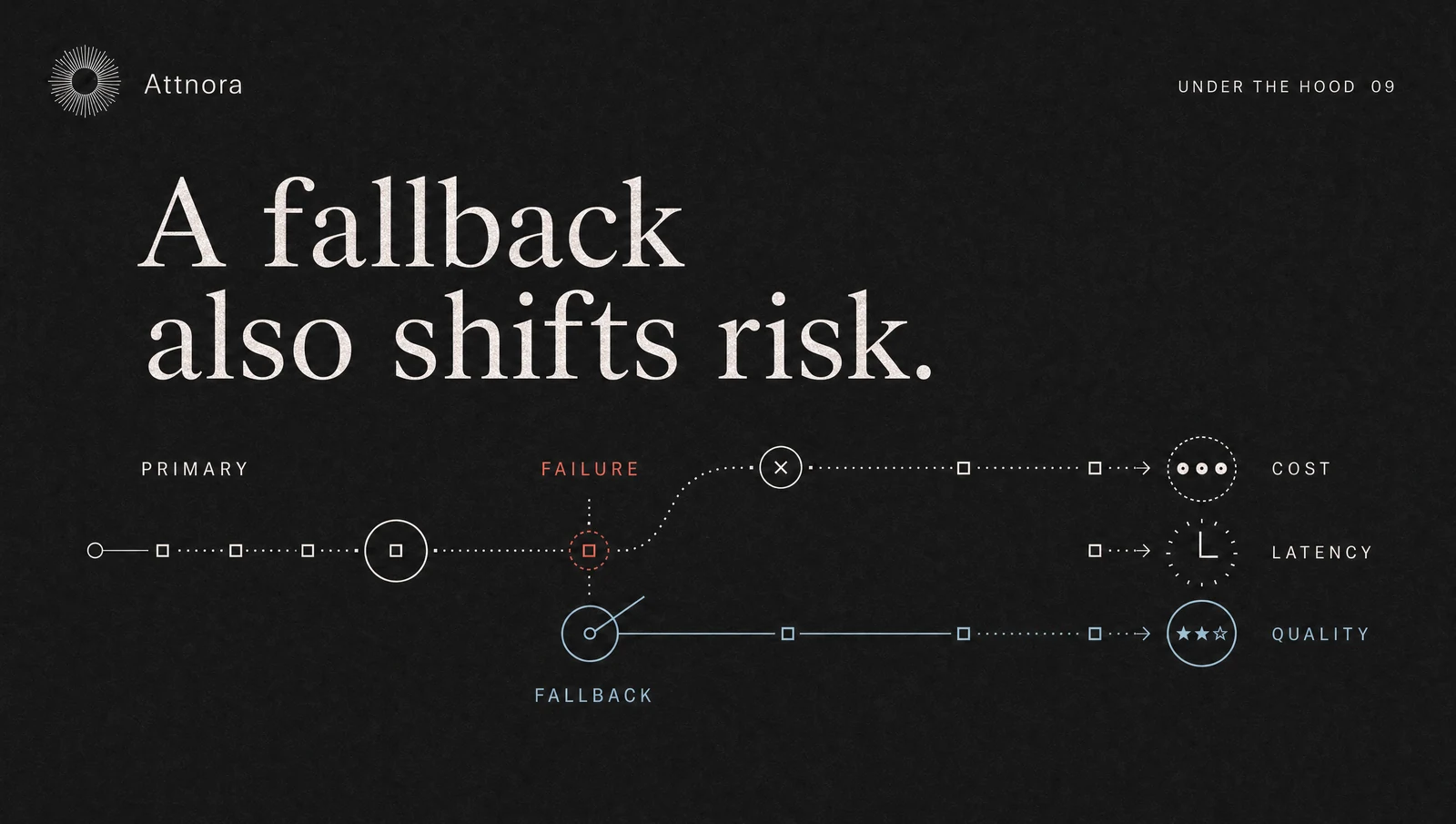
A fallback sounds like a simple reliability feature: if model A does not respond, the system tries model B. In reality, this switch can change the price, data region, output format, safety filters, and response quality.
A fallback is therefore a new route with its own rules, not merely a retry.
Which errors justify a fallback?
Temporary provider errors, rate limits, or regional outages can make a fallback appropriate. Content uncertainty or a poor response, by contrast, should not automatically trigger a provider switch. Otherwise, a quality problem is treated as an availability problem.
Classify errors both technically and in business terms. A different model may not resolve an invalid tool schema. Missing permission must never be bypassed through an alternative route.
Data path before availability
A fallback provider must be permitted for the relevant data class. Check the region, contractual terms, logging, retention, and subprocessors. If no compliant fallback exists, the workflow must stop in a controlled manner.
This also applies to local models. A local route can protect sensitive data, but it can serve as a fallback only if its quality, capacity, and tool capabilities have been tested in advance.
Keep costs visible
A more expensive fallback model can generate significant additional costs during an outage. Set budgets for each route and alert on an unusual proportion of fallback traffic.
Continue attributing the costs to the original workflow. Otherwise, they appear merely as increased spend with one provider, without revealing the process that triggered them.
Validate output and tool calling
Models interpret structured outputs and tools differently. A fallback must satisfy the same contract or have its own adapter and test layer.
At a minimum, test schema compliance, tool selection, source format, safety rules, and termination behaviour. An HTTP 200 response does not establish functional equivalence.
Keep fallback chains short
Long chains can multiply latency and cost. Define no more than one or two permitted alternatives and an overall time limit. After several provider errors, a transparent failure is often better than another uncertain route.
Avoid cycles. The gateway must detect when model A falls back to B and a downstream component then falls back to A again.
Test regularly
A fallback that is never tested is not a reliable control. Simulate provider failures and check the data route, cost alert, format, user notification, and recovery. Document when the system switches back to the primary route.
Sources
- Cloudflare AI Gateway, Dynamic Routing: https://developers.cloudflare.com/ai-gateway/features/dynamic-routing/
- LiteLLM, Reliability and Fallbacks: https://docs.litellm.ai/docs/proxy/reliability
- Google SRE Book, Handling Overload: https://sre.google/sre-book/handling-overload/
- OpenTelemetry Semantic Conventions for GenAI: https://opentelemetry.io/docs/specs/semconv/gen-ai/
Next step
For each production route, list the primary provider and every permitted alternative. Add the data class, region, quality threshold, additional cost, and maximum number of attempts. Then run a planned failure test and inspect the result actually produced.