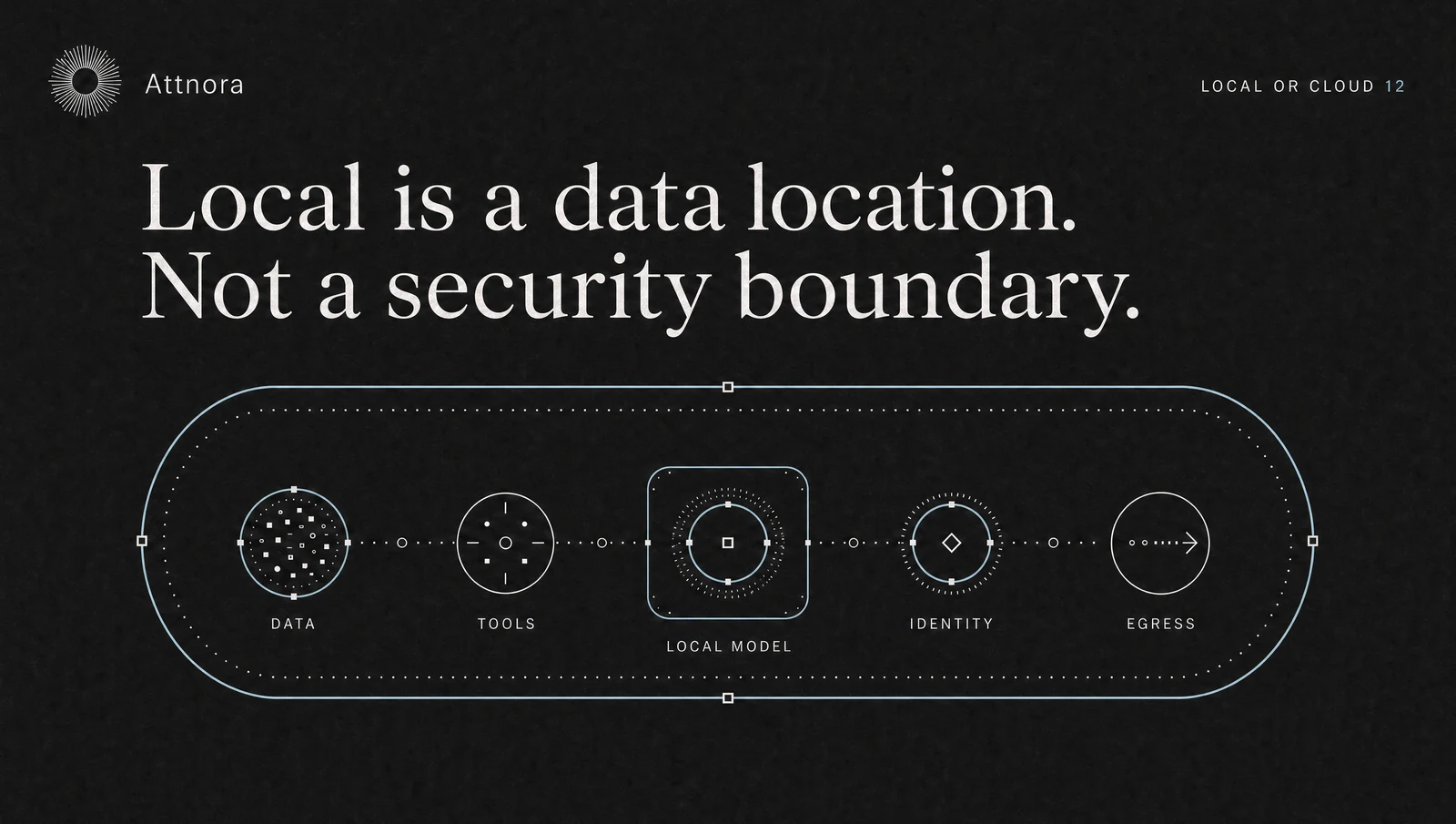
A local AI agent does not necessarily send model requests to an external API provider. This can simplify the data path, but it does not make the agent secure. The agent processes documents, loads models and extensions, calls tools, and writes logs. Each of these interfaces creates its own attack surface.
On 27 July 2026, Hugging Face announced that it was joining the Open Secure AI Alliance. Initiatives like this signal that open models and AI software require shared work on supply-chain security and system security. Membership itself does not prove that a specific system is secure.
Control artefacts and provenance
Model files, quantisations, containers, and Python packages should come from traceable sources. Record the version, hash, licence, and creator. Check whether a model format can execute code while loading or retrieves additional files.
Mirror approved artefacts in a controlled registry. A production server should not download models from the internet without controls every time it starts.
Isolate the model runtime
Run inference with minimal system privileges. Separate the model server, agent logic, and tools into distinct processes or environments. The model server normally does not need direct access to file systems, CRM platforms, or email.
Restrict network access. A local agent is not truly local if plugins and tools can reach arbitrary external endpoints.
Give tools fewer permissions than the user
An agent should not automatically inherit all user permissions. Give each tool task-specific read or write access. Payments, deletions, exports, and public communications require separate approvals.
Prompt injection remains relevant in local deployments. A manipulated document can attempt to induce the agent to perform a tool action. The runtime must technically block unauthorised actions.
Treat logs as sensitive data
Local operation can create an incentive to log everything. However, prompts, tool outputs, and memory often contain personal data or trade secrets. Define masking, access, and retention periods.
Audit metadata and debugging content can be stored separately. For many investigations, a reference to the source, model version, and action is sufficient.
Introduce updates in a controlled way
A new model or quantisation is a production change. Re-test quality, tool behaviour, resource requirements, and security boundaries. Keep the previous version available for rollback.
Automatic updates without evaluation are particularly risky when agents have write access.
Test attacks and failures
Deliberately test manipulated documents, invalid tool parameters, missing permissions, excessively long inputs, and network failures. Verify that the agent stops, does not perform prohibited actions, and creates a usable audit trail.
Sources
- OpenSSF, Open Source Software Security: https://openssf.org/
- OWASP Top 10 for LLM Applications: https://owasp.org/www-project-top-10-for-large-language-model-applications/
- Hugging Face, Security and Access Control: https://huggingface.co/docs/hub/security
- Hugging Face on X, 27 July 2026: https://x.com/huggingface/status/2081718698608402818
Next step
Map the complete path of a local agent, from its model file and container to its sources, tools, and logs. Mark every point with network, file, or write access, and remove any permissions the pilot does not require.